Helmet Albums Ranked: From Worst to Best

Helmet made a heavy riff feel like a precision instrument. Page Hamilton's clipped guitar figures, sour melodies, and abrupt changes in emphasis gave the band a language that could be brutally simple and surprisingly difficult to imitate.

Across these nine studio albums, that sound moves from the raw scrape of the early records toward more melodic and occasionally more experimental territory. This December Hotel ranking counts down from No. 9 to No. 1, with Meantime taking the top spot.

Helmet - Left album cover

9. Left

2023

Left still has the clipped attack and stubborn rhythmic habits that make Helmet recognizable within a few bars. The problem is that the riffs too often announce themselves without developing into songs that demand another listen. Hamilton's harsher vocal approach adds abrasion, but it can leave the melodies struggling for room. The quieter passages provide some contrast, suggesting a more interesting record somewhere between the familiar pounding and the moments of hesitation. There is enough bite here to reward a committed fan, though it lands at the bottom of a catalog whose strongest records make every repetition count.


Helmet - Dead to the World album cover

8. Dead to the World

2016

Dead to the World makes a reasonable case for Helmet as a melodic heavy rock band, even when the results are uneven. The guitars still have weight, but several songs give their choruses more room than the early records would have allowed. That openness is welcome when the tune can carry it; elsewhere, the familiar crunch ends up doing most of the work. The record is most engaging when a change in texture interrupts the expected pattern and gives Hamilton something different to push against. It has its pleasures, but the hooks and the menace rarely come together with the consistency needed to move it higher.

Helmet - Seeing Eye Dog album cover

7. Seeing Eye Dog

2010

Seeing Eye Dog benefits from a willingness to let some air into Helmet's tightly controlled sound. The more spacious passages give the heavy guitars a different setting, making their return feel less automatic. Hamilton sounds interested in texture as well as impact, and that curiosity supplies several of the album's better moments. The trouble comes when those ideas feel like pauses between riffs rather than parts of fully resolved songs. It is an interesting, sometimes rewarding record whose experiments make it easier to appreciate than to love from beginning to end.

Helmet - Monochrome album cover

6. Monochrome

2006

Monochrome brings the emphasis back to the riff, with a dry, grinding attack that suits the band's name. Its best passages find a satisfying balance between mechanical repetition and the little rhythmic displacements that keep Helmet from sounding ordinary. There is less polish around the edges than on Size Matters, which gives the guitars a welcome roughness. Across a full album, though, that narrow focus can make the songs blur together before their individual hooks have taken hold. It is a sturdy entry with plenty of physical force, but fewer moments that linger once the noise stops.

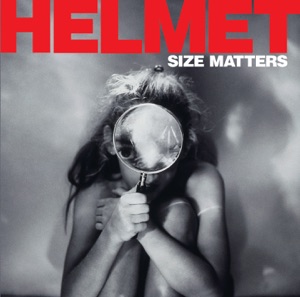
Helmet - Size Matters album cover

5. Size Matters

2004

Size Matters introduces a more polished version of Helmet, with vocal melodies pushed closer to the front of the mix. That shift sometimes smooths away the friction that made the earlier records so distinctive, but it also gives the strongest songs an immediate pull. Hamilton can still build a heavy arrangement around a small guitar figure, and the better choruses give those figures somewhere useful to go. The album works best when its accessible shape and abrasive playing seem to challenge each other. It cannot recreate the chemistry of the original lineup, yet it earns the highest position among the later records by giving its hooks enough substance to survive the production.

Helmet - Aftertaste album cover

4. Aftertaste

1997

Aftertaste tightens the band's writing into a set of compact songs that leave less room for the detours heard on Betty. The guitars retain their clipped, abrasive character, while Hamilton's melodies make the arrangements easier to enter. "Exactly What You Wanted" and "Driving Nowhere" show how well that balance can work when a clear hook has something jagged underneath it. The uniform attack occasionally makes the middle stretch feel narrower than it needs to, but the rhythm section keeps finding movement inside the framework. It places fourth because its focus is both its strength and its limitation: a strong Helmet record with fewer surprises than the three above it.

Read the Aftertaste review →

Helmet - Strap It On album cover

3. Strap It On

1990

Strap It On captures Helmet before the rough surfaces had been filed into the more controlled attack of Meantime. The guitars scrape as much as they pound, and the spaces between the hits can feel almost as hostile as the riffs themselves. There is a restless quality to the playing that makes the repetition feel unstable rather than merely disciplined. The record's rawness occasionally obscures the shape of a song, but it also gives the performances a tension that the later albums rarely match. It earns third place through the force of that personality: ugly, wiry, and already unmistakably Helmet.

Helmet - Betty album cover

2. Betty

1994

Betty takes the precision of Meantime and lets stranger ideas interfere with it. The heavy passages remain formidable, but changes in tone and unexpected turns make the album feel less predictable than its predecessor. "Milquetoast" and "Wilma's Rainbow" demonstrate how much melody Helmet could accommodate without surrendering their awkward rhythmic character. John Stanier's drumming helps the music stay physically convincing even when the arrangements wander away from a straightforward assault. It finishes a close second because its curiosity gives the band a wider expressive range, while Meantime holds the advantage in sustained impact.

Read the Betty review →

Helmet - Meantime album cover

1. Meantime

1992

Meantime is the point where Helmet's sound feels most completely realized: enormous guitar weight, spare arrangements, and a rhythm section that makes every stop matter. "Unsung" has an obvious hook, but its lasting appeal comes from the tension between that hook and the playing around it. Across the album, Hamilton's riffs are memorable because of their placement and attack as much as the notes themselves. The performances keep that disciplined framework alive, turning repetition into pressure without letting the songs become static. It takes No. 1 because no other Helmet album sustains this level of focus, groove, and blunt physical excitement so convincingly.

Read the Meantime review →