|
Album Review
My mixed feelings about
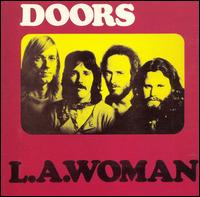
The Doors' final album are probably best summed up in my review of
Marianne Faithfull's
Before The Poison: L.A. Woman
might be one of the best swan songs ever, but Jim Morrison's raspy, drug-,
cigarette-, and alcohol-ravaged voice is a symbol of impending doom,
promises unfulfilled, and death in a bathtub. While claims that Faithfull
was among those who discovered Morrison's body in that infamous Parisian tub
might be the stuff of rock folklore, she had more than a few things in
common with the self-proclaimed Lizard King. Had he survived, perhaps
Morrison's voice, like Faithfull's, would have aged to achieve the
kind of lived-in elegance and wisdom only time and atonement can provide.
L.A. Woman, along with Morrison's view of himself as a poet above all
else (exemplified by 1978's An American Prayer), was an indication
that his work was indeed maturing; though not exactly refined, the album is
a more thoughtful, sober (figuratively and literally—he reportedly wasn't
drunk this time around), and slightly less masturbatory work. Produced by
longtime engineer Bruce Botnick, who also remixed the new expanded
version of the album, and with a back-to-basics approach (old equipment,
little reverb or fuss, and only a smattering of fuzz distortion), it's
consistent in tone and quality. The album expands on and fully commits to
the blues sound of
Morrison Hotel, opening with the James
Brown funk swagger of "The Changeling" and continuing with
the rollicking lead single, "Love Her Madly."
Robby Krieger, Ray Manzarek, and John Densmore were never
tighter; L.A. Woman is the sound of a band in perfect harmony. But
the role of the various bassists they hired over the course of six albums
shouldn't be undervalued—Elvis Presley bassist Jerry
Scheff's work here is fantastic. By 1971, The Doors had become masters
of mood-setting, Krieger's electric guitar replicating the sound of a car
engine on the title track and, on "L'America," creating tension in
its quest for the perfect rhythm, with bass, keys, and drums honing in on
the groove one at a time. Morrison's portraits of America had grown
increasingly disturbing and cynical over the years, and these songs were no
exception. New York may have adopted The Doors as their own, but the band
belonged to the dusty desert roads and highways of the West.
This was no more apparent than on the album's two most recognizable songs,
"L.A. Woman" and "Riders On The Storm." Inspired by the
country-western song "(Ghost) Riders In The Sky: A Cowboy Legend,"
the latter's deft Fender Rhodes work by Manzarek and whispered,
double-tracked vocal provide an ominous, hypnotic backdrop for Morrison's
tale of a homicidal hitchhiker. The song is a more subdued ending for a
Doors album, and complete calm comes at the moment the Rhodes descends and
we're left only with the sound of rain and the steady pulse of Manzarek's
finger on the keys. A clap of thunder provides a defibrillator-like jolt and
the band is brought back to life, defying death and the desert killer, and
riding onward, forever.
--
Sal Cinquemani |