Will the images of 9/11 ever really fade? Not just the
apocalyptic ones -- airplanes crashing through the towers, terrified people
running out of that hellish maelstrom of smoke and dust, the sudden, surreal
collapse of those impossibly tall buildings. Equally -- perhaps even more --
haunting are the subsequent memories, of spouses and parents standing mutely
near Ground Zero, desperately holding photographs of missing loved ones;
dazed cops and firefighters talking about vanished comrades; a new widow,
blinking back tears, clutching her young children as she is interviewed....
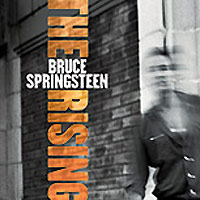
The Rising testifies
eloquently that like all of us, Bruce Springsteen was moved by those scenes.
Leading off the fund-raising TV broadcast days later, appearing alone and
unannounced singing "My City of Ruins," his sorrowful intensity and the
song's evocative imagery crystallized our shared shock and grief, opening
the door not just to that wonderful concert, but also to a glimmer of
healing and hope.
Bruce reminds us in The Rising that 9/11 was more
than a great cataclysm that killed over 2000 people -- it was thousands of
cataclysms, and the victims number far more than the dead -- families,
friends, neighbors...and ultimately, to some degree, all who value life.
9/11 threw a big rock into the placid pond of America's domestic serenity,
and ripples of fear and hate are still spreading.
Bruce's work frequently expresses his feelings about
social and political issues -- especially concerning America's economic
underclass -- although he does not make sweeping pronouncements in the style
of, say, Bono. Bruce speaks through his characters, the narrators of his
songs, and not rhetorically but through the lives that inhabit the songs.
Think of "The River" or "Johnstown," or that most misinterpreted of protest
songs, "Born in the USA."
And so it is here. Bruce's depiction of the consequences
of that terrible day, and of the hate and misunderstanding that have long
marked relations between the U.S. and Arab countries, is told through
personal, intimate songs, through metaphor and allegory. Almost every song
on The Rising expresses basic human emotion: loneliness and loss
("You're Missing," "Paradise"), optimism ("Waitin' on a Sunny Day," "Countin'
on a Miracle"), even flirtation ("Let's Be Friends (Skin to Skin)"). Even
the songs that most unequivocally evoke that day ("Into the Fire," "The
Rising,") unfold through the eyes and emotions of individuals.
Bruce has made albums throughout his career that are
dominated by specific moods and points of view: Darkness on the Edge of
Town, Nebraska and The Ghost of Tom Joad come to mind. But The Rising is
his most thematically unified work, and his first "concept" album since he
rattled Phil Spector's cage with Born to Run.
Rain, clouds and storms appear throughout. These
traditionally suggest sorrow--the literary conceit of "Nature's solemn
sympathy" with the misfortunes of mankind. Images on blood also resonate
throughout, representing in different contexts death and destruction,
revenge - or common human connection and kinship.
But the most potent metaphor here is the kiss, which we
find in almost every song. Veteran fans will know that kisses have long
populated Bruce's work, although to my recollection never quite so
pervasively as on The Rising. For Bruce, the kiss can represent
romance or physical love -- but also forgiveness, understanding, redemption
-- human intimacy in all its variety.
"Lonesome Day" brilliantly sets up the album's themes. The
first stanza would seem to have us in familiar boy-loses-girl territory. But
the second stanza shifts our perspective: disturbing images (Hell's fire,
dark sun, house on fire, viper) culminate in these lines:
A little revenge and this too shall pass
This too shall pass, I'm gonna pray
Right now, all I got's this lonesome day
After an almost desperate-sounding refrain, repeating
"It's all right," the final stanza pleads for care and restraint, not
reflexive revenge:
Better ask questions before you shoot
Deceit and betrayal's bitter fruit
It's hard to swallow, come time to pay.
That taste on your tongue don't easily slip away
If there is any doubt concerning what we're talking about,
the opening lines of the next song, "Into the Fire," make it clear:
The sky was falling and streaked with blood
I heard you calling me,
then you disappeared into dust
Up the stairs, into the fire
Up the stairs, into the fire
I need your kiss, but love and duty
called you someplace higher
Somewhere up the stairs, into the fire
The poignancy of sacrifice depicted in the verses that
follow is balanced by the repeated, anthem-like chorus - which does in fact
reflect the sense of national solidarity and the renewed appreciation for
police and firefighters in the wake of 9/11:
May your strength give us strength
May your faith give us faith
May your hope give us hope
May your love give us love
Throughout The Rising, the song sequencing balances
mood and musical color. For example, the optimistic and musically upbeat "Waitin'
on a Sunny Day" and "Countin' on a Miracle" bookend the dark, subdued
"Nothing Man." The narrator there is a firefighter who survived the towers,
and is now suffering "survivor's guilt" as daily life swirls around him:
Around here, everybody acts the same
Around here, everybody acts like nothing's changed
Friday night, the club meets at Al's Barbecue
The sky's still, the same unbelievable blue
The last line is a brilliant stroke. None of us who were
glued in front of our televisions on 9/11 will ever forget the almost
surreal clear blue sky contrasted to the billowing black smoke--and the
narrator is carrying that memory as part of his burden.
Another jarring sequence comes near the end. "The Rising"
moves from the doomed firefighter in a stairwell to a transcendent vision,
driven by the swelling music and gospel choir. But immediately after that
inspirational climax comes "Paradise" -- perhaps the bleakest of all these
songs. This narrator moves as if through a fog, stuck in this tainted world
"Where the river runs to black." He wants to believe in redemption, in
Paradise, "where the river runs clean and wide," but when he sees a vision
of his lost one, "I search for the peace in your eyes/But they're as empty
as paradise." Although the song ends with a hopeful image of the sun on his
face, it is no more than that.
At the core of The Rising is the sequence of "Empty
Sky," "Worlds Apart" and "Let's Be Friends (Skin to Skin)." The opening
stanza of "Empty Sky" virtually encapsulates the album's themes:
I woke up this morning
I could hardly breathe
Just an empty impression
In the bed where you used to be
I want a kiss from your lips
I want an eye for an eye
I woke up this morning to an empty sky
This is great songwriting. The "empty impression" - the
narrator's individual loss - is microcosm to the macrocosm of the empty sky
- the great cataclysm, which is also evoked by the second line. Sadness over
his loss - "I want a kiss from your lips" - leads to anger and thoughts of
revenge: "I want an eye for an eye." The allegory of the final stanza,
moving to "the plains of Jordan," with the tree of evil/good, evokes the
Middle East and suggests that there are no clear black-and-white answers.
That geographical shift also sets up the next song.
"Worlds Apart" begins like a variation on West Side Story
-- lovers separated by cultural differences. But Arabic-sounding chants and
instruments, together with references to "this dry and troubled country" and
"Allah's blessed rain" leave no doubt that the song is an allegory of
America and the Middle East. Bruce boils down the decades of mutual
deception, economic exploitation and political double-dealing in this
brilliant verse:
Sometimes the truth just ain't enough
Or it's too much in times like this
Let's throw the truth away, we'll find it in this kiss
In your skin upon my skin, in the beating of our hearts
May the living let us in, before the dead tear us apart
"Let's Be Friends (Skin to Skin)" takes these ideas
further yet. Over a catchy, seductive shuffle, the words plead for a fresh
start:
I know we're different you and me
Got a different way of walkin'
The time has come to let the past be history
Yeah, if we could just start talking
Probably no two populaces know less about the realities
of each other's everyday lives than the American people and the Moslem
masses of the Middle East. And given the attitudes of the people in power on
both sides, it's unlikely that the situation will improve in the foreseeable
future. But we want our artists to offer a vision, not calculate odds, and
so we can take this refrain as a flight of utopian fancy -- sort of like
John Lennon's "Imagine":
Don't know when this chance might come again
Good things got a way of comin' to an end
There's a lot of walls need tearin' down
Together we could take them down one by one
Nice thought.
The Rising is not just a
collection of great lyrics. The music dances through many changes, and the
arrangements are consistently appropriate to the words of each song, from
the high-spirited exuberance of "Mary's Place" (reminds me, musically, of "Rosalita")
to the haunting simplicity of "You\re Missing."
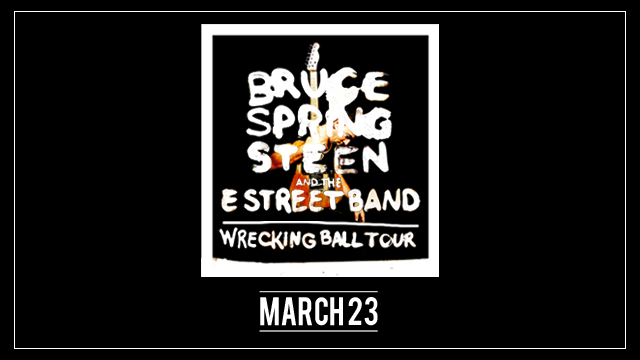
It's wonderful to hear Bruce together with the E Street
Band. In the years since Born in the USA, much as I have liked almost
all of Bruce's work, I can't count how many times I have found myself
wondering how a given song would sound with the E Streeters. Building on the
rock-solid propulsion of Max Weinberg's powerful drumming and Garry
Tallent's agile bass, Steve Van Zandt and Nils Lofgren contribute killer
rhythm guitar. Bruce's economical but passionate solos are spotted through
the album, and I get a little chill of nostalgic E Street pleasure when I
hear Danny Federici's fills on the B3, or Roy Bittan's poetic keyboard
introductions, or especially Clarence Clemons' great saxophone (check out
his bridge on "Mary's Place"). It also seems especially fitting to have
Bruce hooking up with these guys, given the album's tone and subject matter
-- in tough times, it's good to have reliable friends around you.
Much credit must go to producer Brendan O'Brien for the
best-produced recording Bruce has ever made. O'Brien's creative imagination
and taste are essential to achieving the rich textures and sonic variety we
hear on The Rising. I am not normally a fan of strings on rock
records, but here they are integrated beautifully, both in ensemble and
solo. The background voices, whether singing doo-wop syllables or ecstatic
gospel style, add great emotional impact (e.g., "The Rising"). One measure
of O'Brien's success is that even with these complex arrangements, Bruce
never has to shout or strain -- he can sing in a range and volume that allow
him to concentrate on expressiveness and interpretation.
In closing, I want to revisit "My City on Ruins." On that
night back in September 2001 it articulated our grief. That same depth of
sorrow comes through in the two opening stanza is, and even after the
call-to-action "Come on, rise up" chorus, the essential questions of The
Rising remain:
Now there's tears on the pillow
Darlin' where we slept
And you took my heart when you left
Without your sweet kiss
My soul is lost, my friend
Tell me how do I begin again?
My city's in ruins...
And the answer comes, loud and clear, as the full-throated
chorus repeats again and again, "With these hands," as Bruce interjects
variously "I pray for (the strength/the faith/your love) Lord." I'm not a
religious guy, but I can't hear this without a tear in my eye.
The Rising is a mature
masterwork by a quintessentially American artist at the top of his powers,
given outstanding assistance by everyone who worked on the album. Eschewing
knee-jerk jingoism and hate-mongering rhetoric, Bruce offers compassion,
understanding and hope. And since we've been speaking of loss, I'll just say
that if you don't connect with The Rising, the loss will be yours.